The National Ambulance Service (NAS) has recorded significant progress in emergency medical service delivery, workforce development, digital transformation and governance reforms, despite persistent operational challenges affecting response times and service efficiency.
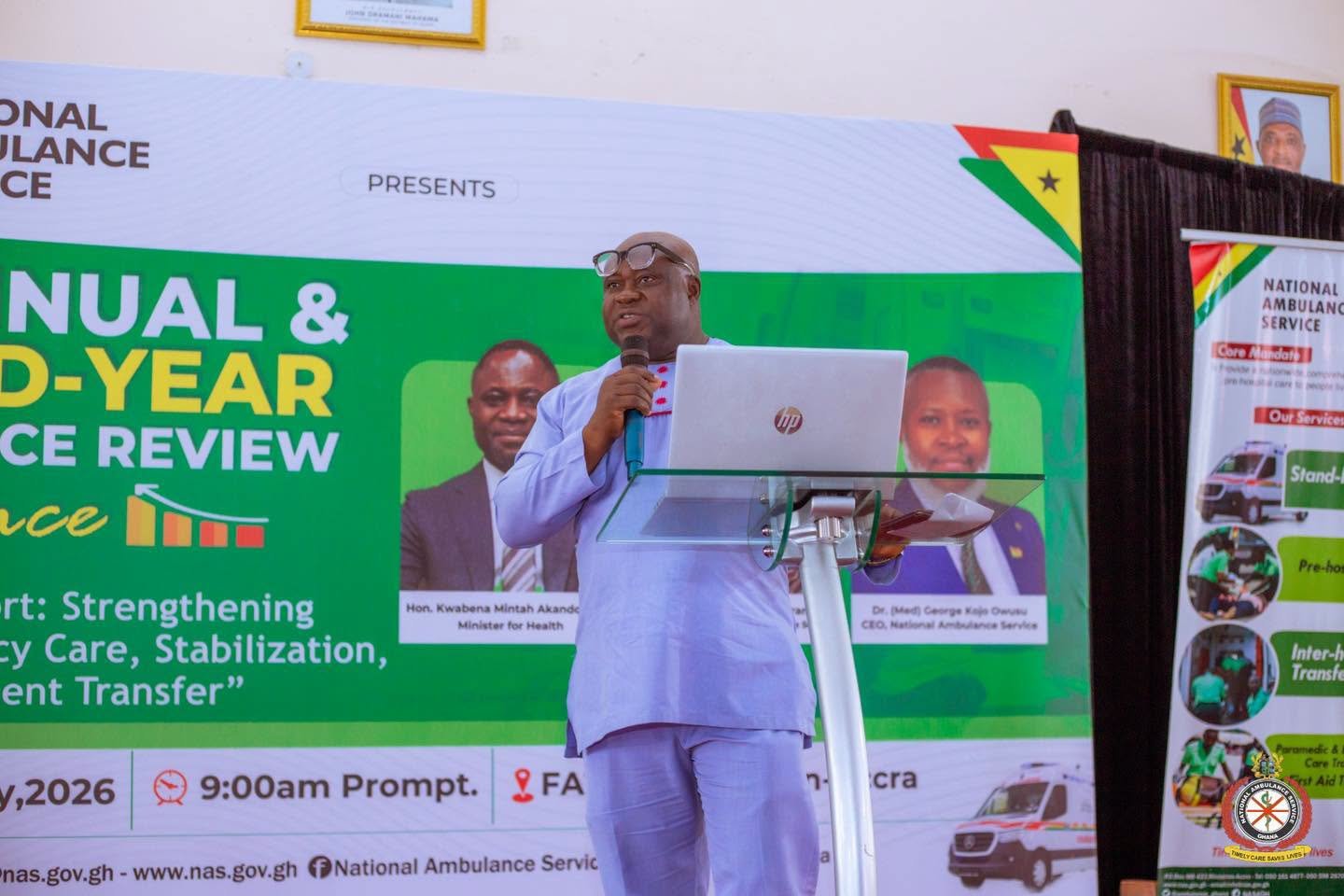
This was disclosed by the Deputy Director for Policy Planning, Research, Monitoring and Evaluation (PPRM&E), Dr. (PhD) Simon Akayiri Nyaaba, during a presentation on the 2025 Annual and 2026 Mid-Year Performance Review at the Service's Annual and Mid-Year Performance Review Conference.
Presenting the Service's performance, Dr. Nyaaba revealed that NAS managed 36,839 emergency cases in 2025, representing a 4.6 per cent increase over the previous year. The Service also received 42,154 emergency calls through the 112 emergency line and dedicated emergency numbers, achieving an 86.7 per cent call completion rate while maintaining operations through its 319 ambulance stations nationwide.
He noted that demand for ambulance services continues to rise, reflecting growing public confidence in the Service. However, 5,587 emergency calls, representing 13.3 per cent, could not be completed due to factors including the unavailability of hospital beds, ambulance shortages, communication challenges, prior transport arrangements, patient deaths and cancellations. To address these challenges, he said the National Bed Management and Referral Coordination System has been introduced to facilitate real-time bed availability and improve referral coordination.
On human resource development, Dr. Nyaaba announced that NAS currently has 3,305 active staff, with 714 personnel promoted in 2025 and 1,334 Emergency Medical Technicians (EMTs) receiving skills enhancement training. He added that approval has been sought to recruit an additional 600 personnel, while 150 degree-holding EMTs have been earmarked for Advanced EMT training. Plans are also underway to establish a degree progression pathway through collaboration with All Nations University.
Dr. Nyaaba further highlighted the Service's investment in capacity building, indicating that 17 training programmes were organised during the first half of 2026, benefiting more than 430 participants across six sectors in partnership with seven strategic institutions. Approximately 6,000 Community Medical First Responders were also trained nationwide to strengthen community-level emergency response.
The Deputy Director disclosed that the NAS fleet currently consists of 319 ambulances, including 26 newly acquired ambulances and 20 modified tricycle ambulances. Five regional mechanical workshops have also been established to improve fleet maintenance, while a Biomedical Engineering Unit has been created and efforts are underway to restore 30 abandoned ambulances at Burma Camp. Additionally, procurement processes have commenced for 400 new ambulances.
As part of its digital transformation agenda, the Service continues to deploy the Personnel Information Management System (PIMS), Station Information Management System (SIMS), E-learning platforms, Fleet Management System, and the National Bed Management and Referral Coordination System to improve operational efficiency, data analytics and referral coordination.
Despite these achievements, Dr. Nyaaba identified an ageing ambulance fleet, staffing shortages, weak systems integration and infrastructure constraints as the major challenges confronting the Service. He observed that most ambulances have exceeded their operational lifespan, while only 78 per cent of ambulance stations are fully functional.
Looking ahead, he said the Service's strategic priorities for 2026 include improving operational efficiency and response times, expanding ambulance coverage, accelerating digital transformation, recruiting and continuously training personnel, strengthening governance systems, and finalising the Legislative Instrument to operationalise the National Ambulance Service Act, 2020 (Act 1041).